
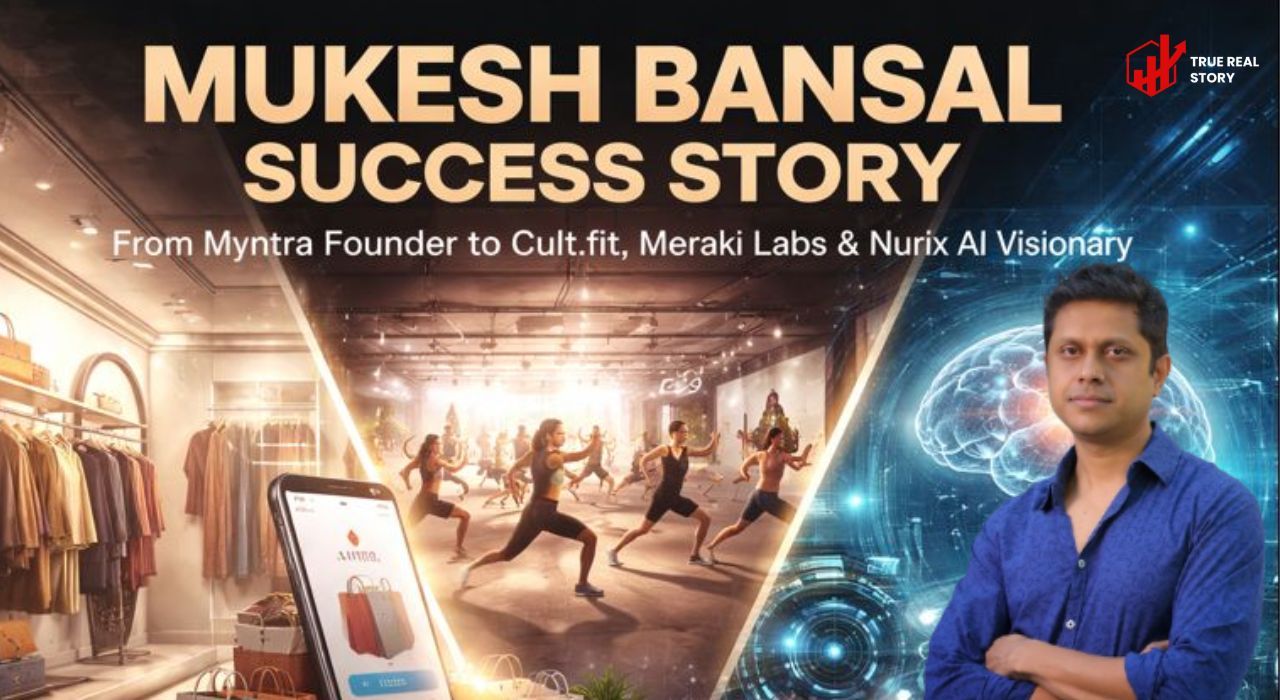
India’s startup ecosystem has produced many celebrated entrepreneurs, but only a few have successfully built, exited, and rebuilt companies across entirely different industries. Mukesh Bansal is one of them.
From co-founding Myntra, one of India’s largest fashion e-commerce platforms, to creating Cult.fit, a category-defining fitness brand, and later moving into deep-tech and AI with Meraki Labs and Nurix AI, Mukesh Bansal’s journey reflects adaptability, long-term vision, and relentless execution.
This article explores the Mukesh Bansal success story, his education, personal life, leadership philosophy, and how he transitioned from fashion to fitness and now artificial intelligence.
Mukesh Bansal is an Indian entrepreneur and startup founder best known as the co-founder of Myntra and the founder of Cult.fit (formerly Cure.fit). Over the years, he has emerged as a serial entrepreneur, building businesses at scale and then reinvesting his experience into new-age ventures.
Unlike founders who remain tied to a single industry, Mukesh Bansal has repeatedly proven his ability to identify emerging consumer needs, build strong teams, and execute with discipline.
One of the most searched topics is Mukesh Bansal education, and it plays a significant role in shaping his analytical thinking.
Mukesh Bansal is an IIT graduate, having completed his engineering degree from IIT Kanpur, one of India’s most prestigious institutions. His IIT stint introduced him to problem-solving at scale, structured thinking, and a culture of innovation.
Before becoming an entrepreneur, he worked in the technology sector, gaining hands-on experience with software systems, consumer internet, and digital platforms. This early exposure would eventually help him see how technology might be used to address real world consumer problems.

A frequent query online is “Mukesh Bansal IAS”, which often leads to confusion.
To clarify:
Mukesh Bansal is NOT an IAS officer.
The confusion likely arises because:
Mukesh Bansal’s success is rooted in entrepreneurship and private enterprise, not civil services.

Mukesh Bansal co-founded Myntra in 2007 with the vision of building a scalable online business. Myntra initially started as a personalized merchandise platform, selling custom T-shirts and products.
However, as the Indian e-commerce ecosystem evolved, the company pivoted toward online fashion retail, a move that would define its future.
Under Mukesh Bansal’s leadership, Myntra:
At a time when online fashion shopping was still gaining trust in India, Myntra positioned itself as a reliable and aspirational platform.
In 2014, Myntra was acquired by Flipkart, marking one of India’s most high-profile startup acquisitions at the time. Mukesh Bansal remained after the acquisition to assist in further growing the business within the Flipkart ecosystem.
This exit established him as a successful startup founder, but it was not the end of his entrepreneurial journey.
Most founders decelerate after a big exit. Mukesh Bansal did the opposite.
He identified a gap in India’s health and fitness ecosystem:
This insight led to the creation of Cult.fit.
Read More Stories:
Gautam Adani Biography & Success Story

Mukesh Bansal founded Cult.fit (Cure.fit) with a simple but powerful idea:
Fitness should be engaging, community-driven, and accessible.
Instead of building conventional gyms, Cult.fit concentrated on
cult.fit rapidly spread across Indian cities, building a dedicated following. What made the brand pop was
The company attracted significant investment and became one of India’s most recognized health-tech startups.
Mukesh Bansal’s approach with Cult.fit demonstrated
After Cult.fit, Mukesh Bansal turned his attention to building and backing early-stage innovation.
Meraki Labs is a startup venture and innovation platform focused on:
From Meraki Labs, Mukesh Bansal has mentored and invested in several startups, applying lessons from his own entrepreneurial journey.

As global technology trends shifted toward artificial intelligence, Mukesh Bansal recognized AI as the next major transformation layer—similar to what e-commerce and mobile internet were a decade earlier.
This led to the creation of Nurix AI.
Nurix AI focuses on:
Rather than chasing hype, the company emphasizes real-world applications of AI in decision-making, automation, and intelligence systems.
Nurix AI represents Mukesh Bansal’s evolution from consumer internet to deep technology.
Mukesh Bansal net worth is a highly searched topic. According to DNAindia.com, Mukesh Bansal net worth is above Rs4,200 crore.
What is known:
Unlike many entrepreneurs, Mukesh Bansal maintains a low public profile regarding personal wealth, focusing instead on building sustainable companies.
Another common query is Mukesh Bansal wife.
Mukesh Bansal is known to be married, but he keeps his personal and family life private and away from media attention. Not much is public about his wife, which is indicative of his desire to keep his personal and professional lives separate.
This privacy aligns with his overall personality—quiet, focused, and execution-driven rather than publicity-oriented.
Here’s the nutshell on Mukesh Bansal’s leadership.
He often emphasizes that companies are built by people, not just ideas.
From fashion to fitness to AI, Mukesh Bansal proves founders can reinvent themselves across industries.
Myntra, Cult.fit and Nurix AI all struck a chord with significant market changes.
Strong operations, branding, and systems matter more than just vision.
Though successful, Mukesh Bansal eschews superfluous media din.
Read More Stories:
Ola CEO Bhavish Aggarwal Story
Shiva Ayyadurai Invention Story
Mukesh Bansal’s journey has:
His legacy through Meraki Labs and AI startups will ensure his impact lives on for years to come.
The Mukesh Bansal success story is not just about building Myntra or scaling Cult.fit. It is about continuous evolution, disciplined thinking, and staying ahead of change.
From his robust educational background to creating category-defining startups, Mukesh Bansal is a compelling example of how India entrepreneurs can compete on the world stage — from fashion, to fitness, to artificial intelligence.
While Meraki Labs and Nurix AI mature, Mukesh Bansal’s story is nowhere near done. In a lot of ways it’s still hitting its stride.
Want to publish your story for free, add your story to TrueRealStory.com
No, after Flipkart acquired Myntra, Mukesh Bansal left Myntra and is not part of the company anymore.
Myntra is owned by Flipkart Group, which is backed by Walmart.
Mukesh Bansal’s latest venture is Nurix AI, which focuses on building AI-first products and enterprise solutions.
Mukesh Bansal has founded or co-founded Myntra, Cult.fit (Cure.fit), Meraki Labs, and Nurix AI.
Nurix AI is set to expand in enterprise AI, automation, intelligence systems as the world craves practical AI
Mukesh Bansal’s exact net worth in 2025 is above Rs4200 crore, according to DNAindia.com estimates vary and are largely based on his equity, exits, and investments.